|
Algebra 1 pointed out some of the "tricky situations" that may be associated with sequences.
In Algebra 2, those "tricky situations" may be more prominent and will demand attention.
This lesson will look at some of the options for dealing with tricky sequences.
 Tricky Situation 1: Tricky Situation 1:
Are you dealing the "beginning" of a time interval, or the "ending"?
Finding Time Intervals: Do the terms in your sequence represent the "time" an event started, or the "time" the event ended? Don't mix them together!
Carl planted a 4 inch sunflower plant. The plant grows 3 inches each week. How tall is the plant at the end of 5 weeks?
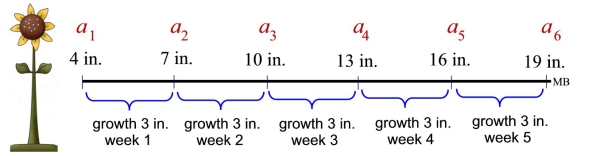
The sequence associated with this problem is actually {7, 10, 13, 16, 19},
representing the values at the END of each time interval.
If you use the starting height of 4 inches, with a time of 5 weeks,
you get the WRONG answer. an = 4 + 3 (n - 1) = 4 + 3(5 - 1) = 16 inches. NOPE!
The easiest way to address this concern, is to remember to use entries that represent the same thing. 7, 10, 13, ... represent the growth at the END of each time interval, which is asked for in this problem. These are the values we are interested in examining.
The 4 is not a height at the "end" of an interval.
Correct answer: an = 7 + 3 (n - 1) = 7 + 3(5 - 1) = 19 inches.
Yes, there are other ways to address this "tick situation".
The key is to remember that it needs to be addressed. |
Tricky Situation 2:
Are you missing information that usually is provided?
Using Simultaneous Equations: You may need to spend some time "finding" the information that appears to be missing.
Find the 30th term of an arithmetic sequence
where the 5th term is 30 and the 12th term is 86.
While we don't know the first term nor the common difference for this sequence
we can set up two equations.
Using an = a + (n - 1) d, we have 30 = a + (5 - 1)d and 86 = a + (12 - 1) d.
Simplifying: 30 = a + 4d and 86 = a + 11d
Two equations with two unknowns means simultaneous equations are an option!
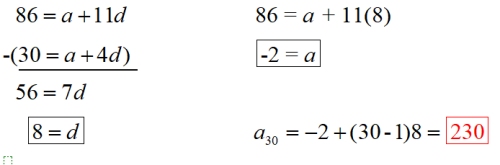

For this specific situation, we saw, in Arithmetic Sequences, that there is another solution option.
If you set up the 5th term to be a new temporary 1st term, we can get
86 to be a new 8th term.
This gives us a first term and the number of terms with which to work.
Common difference
an = a + (n - 1) d,
86 = 30 + (8 - 1)d
86 = 30 + 7d
56 = 7d
8 = d
|
Find the real first term:
an = a + (n - 1) d,
30 = a + (5 - 1) 8
30 = a +
32
a = -2 |
Find the 30th term:
an = a + (n - 1) d,
a30 = -2 + (30 - 1) 8
a30 = -2 +29•8
a30 = 230 |
|
Tricky Situation 3:
What to do if you know NONE of the terms, nor the common difference.
So we know even less than we did in Tricky Situation 2.
Using
the "patterns" associated with arithmetic (or geometric) sequences: The "patterns" offer a way to represent terms in various locations in the sequences.
 (Arithmetic) (Arithmetic)
Pattern: a, a • r, a • r2, a • r3, . . . (Geometric)
The sum of the first four terms of an arithmetic sequence is 28
and the sum of the next four terms is 60.
What is the value of the 25th term?
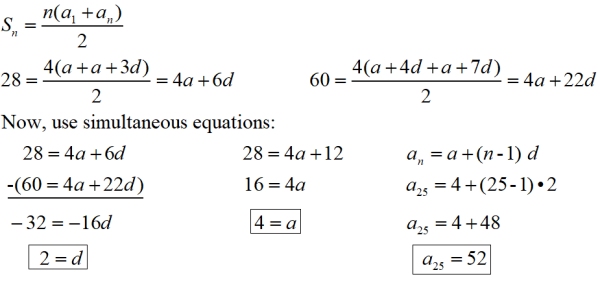
This is a "series" problem dealing with "sums".
And we were given very little information regarding this sequence.
While we do not know any specific terms, we do know how to represent them from our "pattern" for an arithmetic sequence.
In the first four terms, a1 = a and a4 = a + 3d
In the second four terms, a5 = a + 4d and a8 = a + 7d
Use these " expressions" to represent the terms in the formula:
|

NOTE: The re-posting of materials (in part or whole) from this site to the Internet
is copyright violation
and is not considered "fair use" for educators. Please read the "Terms of Use". |
|
|