|
Directions: Questions for Parts II, III, and IV are long response questions. You will need paper, pencil and a graphing calculator to work out the problems. Check your answer after solving each problem by clicking the ANSWER button. |
25. 
|
|
|
26. On what interval(s) is the function f (x) = (x2 - 9)(x2 - 1) decreasing?
Round to nearest thousandths, if needed.
|
|
|
27. Given 
find the value of the constant m.
|
|
|
28. Given f (x) = x4 + 3x3 - 2x2 - 5x - 1 and g(x) = | 1.2x | - 6, find the solutions to f (x) = g(x). Round to nearest hundredths, if needed.
|
|
|
29. The probability that a high school junior opposed the new school logo was 0.8. The probability that a junior favored the new class colors was 0,85. Determine the probability that a randomly selected junior opposed the new logo and favored the new colors.
|
|
|
30. Given (a + b)(a2 +2ab + b2) = 27, find the value of a + b. |
|
|
31. Solve the equation: 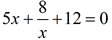 . Express answer in simplest a + bi form. |
|
|
| 32. Polonium-210 is a radioactive element with the property that every 138 days the mass of the element in a sample is reduced by half. (It's half-life is 138 days.) |
|
a) If A0 represents the original mass of polonium-210, write a function to model the amount of polonium-210 remaining at a designated time, t, in days.
b) If you have 100 micrograms of polonium-210, how much will remain after 60 days? |
|
33. Solve for x:  Justify your solution(s). Justify your solution(s).
|
|
|
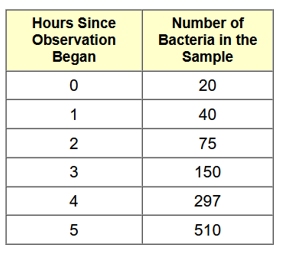
34. A rapidly growing bacteria is being studied. Its growth rate is shown in the chart at the right.
a) Find an exponential regression equation that the scientists can use to model this data. Round to the nearest thousandths.
b) If 12 hours passes, how many bacteria will be in the sample?
|
 |
|
35. Using the identity (a - b)3 = a3 - 3a2b + 3ab2 - b3 ,
expand and simplify (3x - 5)3.
|
|
|
36. Draw at least one complete cycle of a sine graph passing through the point (0,1) with an amplitude of 2, a period of π, and a midline at y = 1.
Using this graph, state an interval where the graph is decreasing.
|
|
| |
|
37. A polynomial function is given as P(x) = x3 - 3x2 + 4.
a) Factor completely, the expression x3 - 3x2 + 4.
b) Graph P(x).
c) Find the coordinates of all relative (local) maxima. Round to nearest tenths if needed.
d) Describe the end behavior of P(x).
e)The graphs of equations of degree 3 often cross the x-axis in three locations, representative of the the three roots. Explain what is happening with this function as it relates to crossing the x-axis. |
|
|
|
|
|
|
|