|
 |
In Algebra 2, the emphasis regarding domain and range will be placed on analyzing advanced functions types, such as absolute value, exponential, logarithmic, piece-wise defined, rational, and radical functions.
Trigonometric function graphs will be discussed in the Trigonometric Graphs section. |
|
R E S T R I C T I N G D O M A I N S
The expression "restricting a domain" refers to the process of deliberately
limiting the allowable input values for a function.
There are two situations that appear regularly in Algebra 2 regarding "restricted domains":
(1) preventing algebraic errors and (2) ensuring the existence of a function.
The first condition will be the more popular.

 |
(Situation 1) It may be necessary to "restrict a domain" to avoid algebraic errors. |
|
Restricting a domain is most often applied to algebraic expressions that are likely
to encounter errors when certain values are entered into the expression.
 Remember that the domain must be the x-values Remember that the domain must be the x-values
that are algebraically allowed by
the equation. |
Restricting the domain can prevent algebraic errors from occurring.
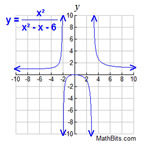
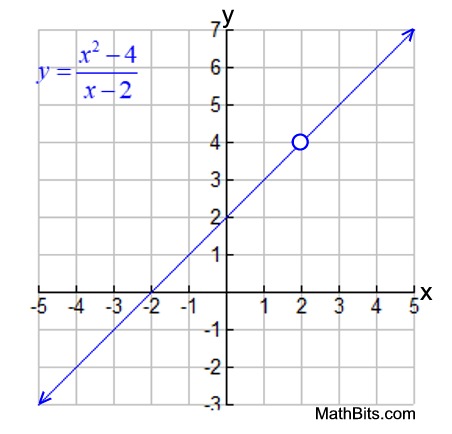
The two most common algebraic errors seen in Algebra 2 are division by zero, and negative values under a simple square root symbol. While these troublesome graphs pass the Vertical Line Test for a function, they have algebraic concerns when it comes to stating their domains.
Restrict domains to prevent D I V I S I O N by Z E R O
State the appropriate domains for functions shown in the tables below.
Restrict domains to prevent N E G A T I V E values under S Q U A R E R O O T S
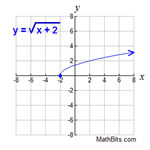
Negative Under a Square Root Symbol:
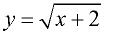
Solution: The value under this square root radical needs to be 0 or a positive number (no negatives under a square root that could create complex numbers). Complex numbers cannot be graphed in a Real Number coordinate plane.
To find the values that are OK to graph, set the value under the square root to be greater than or equal to 0 and solve.
x + 2 > 0, gives x > -2.
Domain: x > -2 or [-2,∞).
|
 |
Negative Under Square Root and Division by Zero:
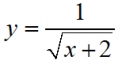
Solution: This is a double whammy! This problem has a square root AND the possibility of division by zero.
Remember that a positive (or zero) must be under the square root symbol, so x + 2 > 0.
But, this value cannot "equal zero" since it resides in the denominator. So, x + 2 > 0.
Solving: x > -2
Domain: x > -2 or (-2,∞).
|
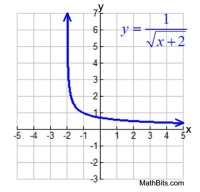 |
Graphs are helpful is showing where domains are located, and where trouble spots are likely.
If you are working with an algebraic function, without a graph, be aware that algebraic error problems may occur.
|
(Situation 2) It may be necessary to restrict a domain to ensure the existence of a function. |
|
We know not all graphs are functions. It may be possible, however, to create "functions" from non-function graphs by restricting which domain elements are used.
The graph of the relation y2 = x or  is shown below on the left. It is clear that this relation fails the Vertical Line Test and is NOT a function. We can, however, separate this graph into its two parts and create two separate "function" graphs.

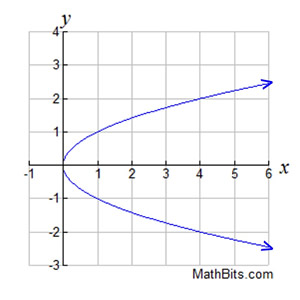
Relation: Domain: [0,∞), Range: (-∞, ∞) |
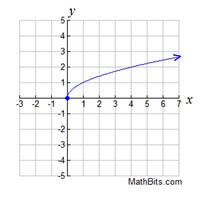
 Domain: [0,∞), Range: [0,∞)
|
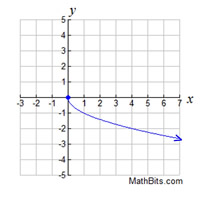
 Domain: [0,∞), Range: {0,-∞)
 |
These separated graphs each pass the Vertical Line Test and are "functions". The domain for both functions is x > 0. The range of the first function is y > 0, and for the second function is y < 0. |
It is possible that a restricted domain may be used as a means of defining a function.
|
Restricted domains may be needed to define a function. |
|
There are situations where a restricted domain is a crucial part of the function's definition.
For these situations, you simply use the given restrictions to work with the function.
You may be asked to find the "range" for these functions.
Piecewise-defined Functions:
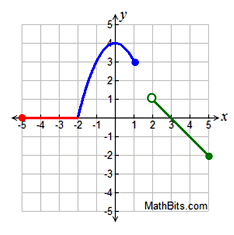
The restricted domain is given
as part of the equation.
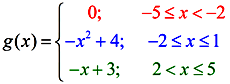
Domain: [-5,1] U (2,5]
Range: [-2, 4] |
Step Functions:
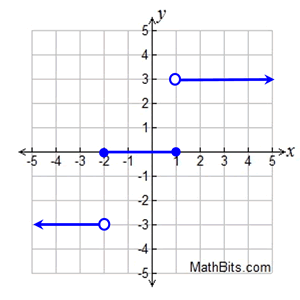 The restricted domain is given The restricted domain is given
as part of the equation.
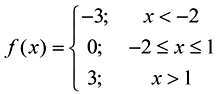
Domain: (∞, -∞)
Range: {-2, 0, 2} |
Certain Word Problems:
Temperature is continuously increasing. The degrees of increase is recorded over 5 days and modeled as y = x + 1, except for day 4 when no reading was recorded.
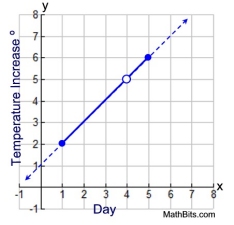
Domain: [1,4) U (4,5]
Range: [2,5) U (5,6]
|
|
If a domain is not stated, it may be the case that all real numbers can be used, BUT...
you are more likely, in Algebra 2, to run into problems, especially algebraic errors.
|
|

NOTE: The re-posting of materials (in part or whole) from this site to the Internet
is copyright violation
and is not considered "fair use" for educators. Please read the "Terms of Use". |
|
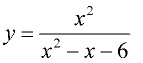
 - {-2} - {3}.