|
The term "composition of functions" (or "composite function") refers to the combining together of two or more functions in a manner where the output from one function becomes the input for the next function.
Mathematically speaking, the range (the y-values) of one function becomes the domain
(the x-values) of the next function.
The notation used for composition is:

and is read "f composed with g of x"
or " f of g of x". |
 Notice how the letters stay in the same order in each expression for the composition. Notice how the letters stay in the same order in each expression for the composition.
The letters f (g(x)) tell you to start with the function g (always start with the function in the innermost parentheses). |
|
|
If you become confused as to where to start when you see the notation  , start by rewriting the notation to be f ( g( x)). Then you can see that you need to start with the innermost parentheses, which in this case will be function g. |

Composition of functions can be described as a series of "picking up" and "dropping off". A function picks up x, does something to it, and drops it off. Then another function comes along and picks up the drop off, does something to it, and drops it off again. This pattern may continue over several functions.
You can think of composition as a series of taxi cab rides. Person x is picked up by the first taxi function, transported to a location, and dropped off. Then another taxi function comes along and picks up person x at this new location, transports person x to another new location, and drops person x off.
Visual Example:
Take a look at the picture below which shows how functions f and g work together to create a composition . The starting domain for function g is limited to the values 1, 2, 3, and 4.
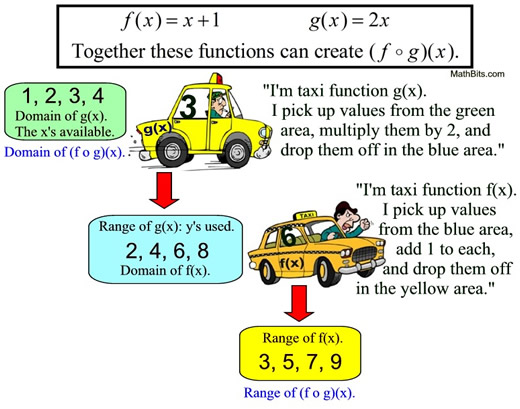

What starts at x = 3, ends up at y = 7.
Under the composition in this example, the following ordered pairs (x,y) are created:
(1,3), (2,5), (3,7), and (4,9).
Now, suppose we wish to write this composition as an algebraic expression,
combining function f (x) with function g(x).
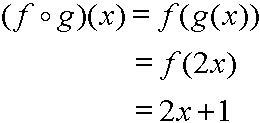 Algebraic expression
for the composition of the taxi rides. |
1. Substitute the expression for function g (the 2x) for g(x) in the composition. This will clearly show you the order of the substitutions that will need to be made.
2. Now, substitute the expression 2x into function f in place of its x-value. Perform any needed simplifications (none needed in this example). |
The concept of composite functions is actually widely used.
You have already been using composition of functions when entering
certain expressions into your calculator. |
|

Evaluate:

|
Consider the problem at the left. When entering this computation into a calculator, you will press the key to square a value and the key to raise a value to a power (exponentiation). These keys represent the functions of squaring and exponentiation. You are doing a composition of functions. The problem could be represented as:
, evaluated at x = 3.6
where f ( x) = πx and g( x) = x2.
(The order of entry will vary depending upon the model of calculator.)
|
 |
When dealing with composition ...
|
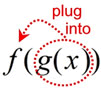 |
Always start with the function
on the right! |
|
Algebraic Examples:
1. Given f (x) = 5x + 1 and g (x) = 3x - 2.
 |
Solution:


2. Given f (x) = 3x2 + 4x + 7 and g (x) = x + 1.
 |
Solution:


3. Given f (x) = x2 - 1 and g (x) = 3x + 2.
 |
Solution:




4. Given f (x) = x2, g (x) = x - 1 and h (x) = ½ x.

|
Solution:


Applied Example:
Let's look at an actual application of compositions in the real world:
| 5. An electric bike is traveling at a constant speed of 18 miles per hour. The distance traveled, in miles, is given by the formula d (t) = 18t where t is the number of hour traveled. The energy consumption (electricity) of the bike is 12 Watt-hours per mile. The equation w(d) = d /12 can represent the amount of Watt-hours (electricity) used in relation to the number of miles traveled.
If the electric bike travels for 2 hours, how many Watt-hours of electricity are used? |
Solution:
Formula for finding distance: d(t) = 18t. So, in 2 hours, the bike traveled d(2) = 18(2) = 36 mi.
Formula for Watt-hours used: w(d) = d/12. So, for 36 miles, the bike use w(d) = 36/12 = 3 Wh.
The two formulas can be combined (composed) into one formula.
When time = 2 hours, (w(d (t)) = w(36) = 3 Watt-hours
|
For calculator help with
composition
of functions
click here. |
|

NOTE: The re-posting of materials (in part or whole) from this site to the Internet
is copyright violation
and is not considered "fair use" for educators. Please read the "Terms of Use". |
|